LYRICS
O gracious God! How merciful are all Your ways to me,
Whose sinful, darkened, rebel mind was enmity with Thee;
Yet now, subdued by sovereign grace,
My spirit feels Your warm embrace.
How kind are Your ways, O God.
How precious are Your thoughts, O God, too numerous to know
They fill and flood my feeble heart, and captivate my soul;
How great their sum, how high they rise,
Cannot be measured with the skies.
How kind are Your ways, O God.
O God of Heaven, Your majesty is high above the earth.
The skies proclaim with endless speech Your glory, power, and worth.
Lord, what is man, this wretched foe,
That You would love and bless us so?
How kind are Your ways, O God.
Preserved in Jesus, when my soul and feet made haste to hell;
And there should I have justly gone, but You do all things well;
Your love was great, Your mercy free,
And from the pit You rescued me.
How kind are Your ways, O God.
A trophy of Your graciousness, this sinner saved by blood:
The streams of love my soul can trace up to the Fountain, God;
And in Your holy heart, I see
Eternal thoughts of love for me!
How kind are Your ways, O God.
Original Lyrics by John Kent, 1803.
Lyric adaptation and music by Gary Brumley
© 2009 New Moniker Music. CCLI Song Number: 5452246
SHEET MUSIC
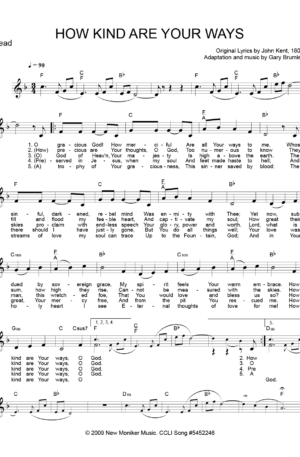
COVER RECORDING
I am honored that this song was beautifully covered by Darby Hughes and Madison Davis.
ABOUT
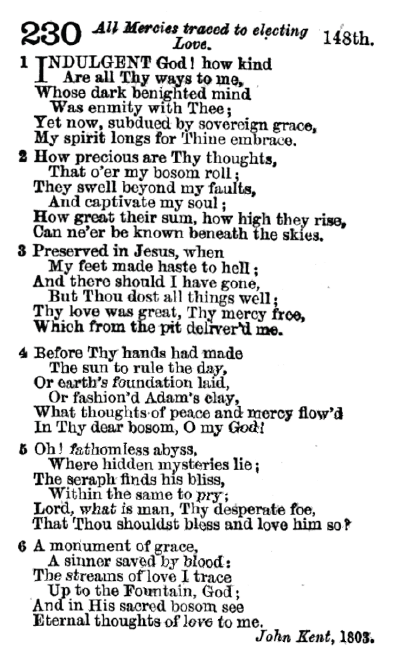
The text of this hymn was written by John Kent (1766–1843), a humble shipwright who labored in the Plymouth dockyards of England. Though he had little formal education, Kent possessed a deep theological mind and a remarkable gift for verse. He first published this hymn in 1803 in his collection Original Gospel Hymns, where it originally opened with the striking line, “Indulgent God, how kind are all Thy ways to me.”
The hymn gained enduring prominence when C. H. Spurgeon selected it for his influential 1866 hymnal, Our Own Hymn-Book. Known as the “Prince of Preachers,” Spurgeon had a particular affection for Kent’s “strongly worded and intensely Calvinistic” hymns and frequently employed them at the Metropolitan Tabernacle to underscore the doctrines of grace.
I first attempted to revive this old hymn in 2005 and introduced it to my church body. It was a dud. The music felt uninspired and forgettable. I set that version aside, retaining the text with the hope of revisiting it later.
Four years later, while planning worship for an upcoming gathering with my church body, I returned to Kent’s text. The sermon would culminate in God’s kindness toward those who, walking in the darkness of unbelief and rebellion, fall short of obedience—a theme captured in the hymn’s opening line. On Tuesday of that week, I again attempted to craft a suitable melody, but none of the ideas seemed to cohere. On Thursday, our family suffered a loss that plunged me into deep grief. The following day, in the midst of that grief and while reflecting on the theological truths of the text, the ascending melody line—or melodic “cry”—began to take shape. I completed the setting on Friday and introduced it at Redeemer Church that Sunday. It was warmly received by the congregation and has remained in regular use.
Kent’s nineteenth-century words on God’s indulgent kindness had largely disappeared from hymnals, scarcely appearing after the 19th century. It is my prayer that this modern adaptation may help worshipers meditate afresh on the kindness of God and His “eternal thoughts of love” toward sinners saved by grace.
Original Words
Permissions
All resources are provided with permission to use freely in your church, ministry, or home. CCLI license holders, please report any usage during reporting periods. If you would like to record or publish any of these materials, please make that request through the contact page.